
RugOne Xever 8 rugged phone review

Why you can trust TechRadar
We spend hours testing every product or service we review, so you can be sure you’re buying the best. Find out more about how we test.
RugOne Xever 8: 30-second review
While this phone won’t make our best rugged phone collection, what it offers might be perfect for some customers, and it is reasonably affordable for a phone with a swappable battery.
RugOne is Ulefone’s premium rugged sub-brand, launched in late 2025. It targets buyers who want a genuinely capable device rather than a cheap, rough-and-ready handset. The Xever 8 is the entry point to the second generation of that vision. It arrived in May 2026 and carries forward the headline idea from the Xever 7 series: a battery you can swap without powering down the phone.
That concept matures here into what RugOne calls Swappable Battery 2.0. The claim is that critical apps stay running throughout the swap, and within quite narrow criteria, it achieves that.
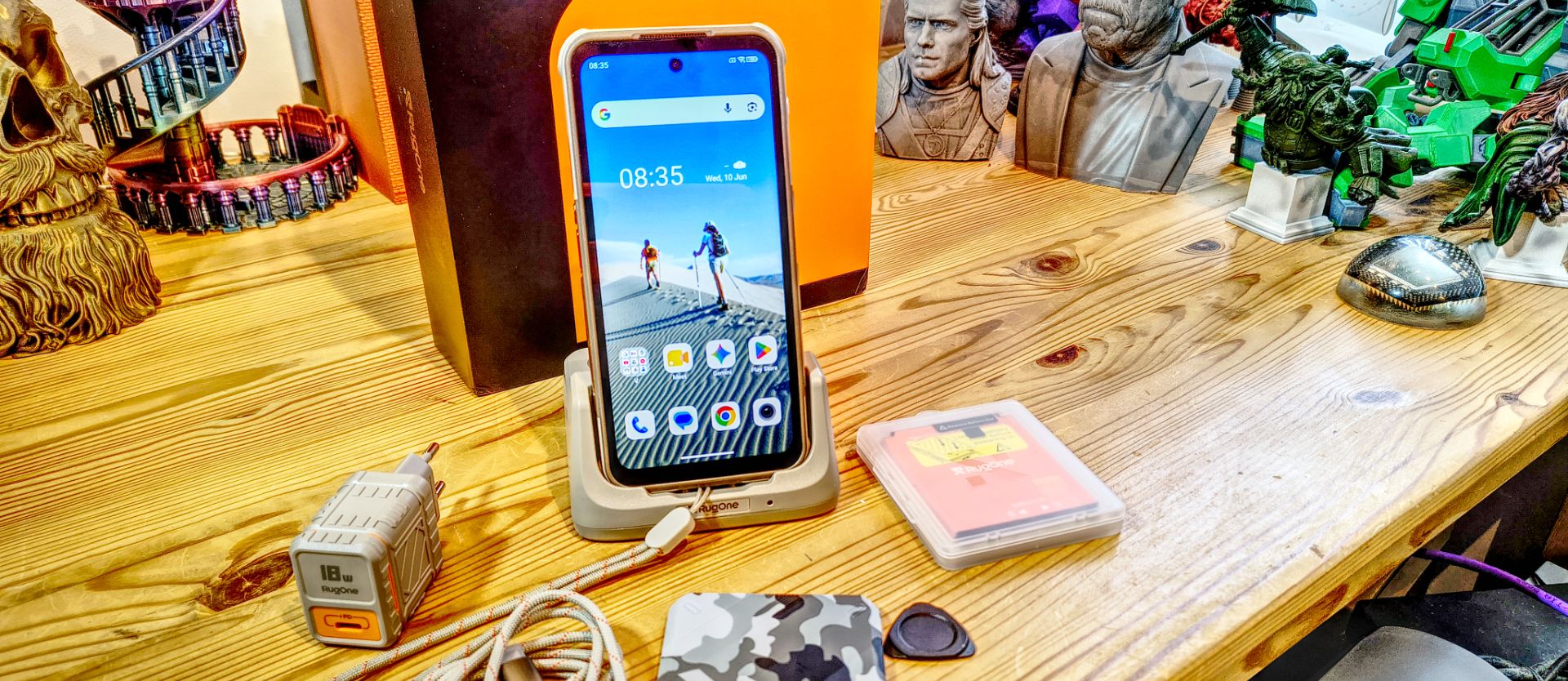
I can confirm that the Xever 8 ships with two 4,800mAh batteries and a charging dock in the box. For field workers and outdoor users who simply cannot afford downtime, the proposition is clear.
There is a catch, though, and it is worth addressing upfront. The Xever 7 was a 5G device with a Dimensity 8020 chipset. The Xever 8 steps down to a Helio G200 on a 4G-only platform. For a phone launching in 2026, that is a significant concession, and it, to some degree, negates some of the advantages this phone has over its previous generation. RugOne made a deliberate trade-off, prioritising the battery system and audio hardware over performance. Whether buyers agree that trade is fair depends heavily on what they need most.
With a better SoC, this might have been one of the best rugged phones, but it appears that we might need to wait until the Xever 9 to get all these ducks in a row.

RugOne Xever 8: price and availability
- How much does it cost? $368/£380
- When is it out? Available now
- Where can you get it? You can get it directly from RugOne or via many online retailers such as AliExpress.
The RugOne Xever 8 comes in two colors, Back and Sand Dune, and each of these offers two SKUs, one with 128GB of storage and another with 256GB.
While the machine is shown on the RugOne website, there isn’t any option to buy it from the maker, and I was forced to search for it elsewhere. The only place I could find it was AliExpress, and for US customers, the only option is the 128GB model for $367.99.
UK customers get both capacity phones, with the 128GB being £379.39 and the 256GB option (reviewed here) being £414.59. Spending £35.20 and getting an extra 128GB of storage doesn’t seem like a poor deal. It doesn’t appear to be available to those in the EU at this time, but I suspect it will be at some point.
I complained that the previous RugOne Xever 7 Pro was too expensive, and admittedly, its predecessor, the Xever 8, is cheaper. However, given its specifications, it should be less.
The obvious competitor for this phone is the Samsung Galaxy XCover7 Pro, a phone that sells for roughly $560 in the USA, and £425 in the UK. That’s for a phone with only 128GB of storage and a single battery. Batteries are freely available for around £22 each. The Samsung Galaxy XCover7 Pro uses a Snapdragon 7 Gen3 SoC, making it a substantially more powerful device, justifying some of that extra cost.
The Xever 8 is a better value than its Xever 7 Pro predecessor, but it’s hardly a bargain in the remarkably competitive rugged phone sector. What helps RugOne justify the price somewhat is the relatively small number of designs with replaceable batteries.

RugOne Xever 8: Specs
|
Item |
Spec |
|
CPU: |
MediaTek Helio G200 (6nm) |
|
GPU: |
Mali-G57 MC2 |
|
NPU: |
N/A |
|
RAM: |
8GB |
|
Storage: |
256GB UFS 2.2 |
|
Screen: |
6.5-inch IPS Screen |
|
Resolution: |
1080 x 2400 FHD+, 120Hz, 680 nits |
|
SIM: |
2x Nano SIM + TF + eSIM (all can be used) |
|
Weight: |
320 grams |
|
Dimensions: |
168 x 80 x 14mm |
|
Rugged Spec: |
IP68 IP69K dust/water resistant (up to 2m for 30 minutes), MIL-STD-810H Certification |
|
Rear cameras: |
64MP Main Camera + 20 MP Night Vision Camera |
|
Front camera: |
32MP |
|
Networking: |
4G LTE. WiFi 5, Bluetooth 5.2 |
|
Audio: |
3.5mm audio jack for headphones |
|
OS: |
Android 15 (updates promised) |
|
Battery: |
4600 mAh (Max 33W wired, dock included) hot-swapable |
|
Colours: |
Sand Dune, Black |
RugOne Xever 8: Design
- Industrial aesthetic
- Extra custom buttons
- Easily swappable batteries

In many ways, this phone is a derivative of the Xever 7 Pro, but with some extra elegance and refinement in places. That it comes with the charging stand, a second battery, a charger, and a bunch of other accessories does make it feel more worthy of the asking price.
The Xever 8 measures 168 x 80 x 14mm and weighs 320g. It is not especially light or slim, but it fits better into a pocket than some rugged phones I’ve reviewed. That is the reality of a phone engineered to survive two-metre drops, high-pressure water jets, and the demands of MIL-STD-810H testing. The IP69K rating alongside IP68 is notable. IP69K specifically covers resistance to high-temperature, high-pressure water streams, which is relevant in agricultural and industrial settings where a regular waterproof phone would fail.
RugOne has tried to soften the bulk with bevelled edges designed for grip. The company calls the speaker and camera module arrangement symmetrical, which is unusual in this category. Two colourways are available: Black and Sand Dune. The latter is a muted, low-saturation tone clearly inspired by the rugged outdoor aesthetic that is now common across the category.
The rear cover is removable, obviously, since the battery sits beneath it. The dual-latch system on that cover is a practical addition. An internal latch secures the battery cell itself, and the outer cover adds a second retention point. The claim is that this significantly improves drop resistance at the point where a single-latch design would typically allow the battery to shift on impact.

A dedicated button on the side can be used to activate the TorchX flashlight, rated at 230 lumens. That is a useful addition for anyone working in unlit environments. The 3.5mm headphone jack is also present on the top edge. These are small decisions that matter to the people this phone is built for.
The Xever 8 uses a 6.5-inch IPS LCD panel running at 1080 x 2400 pixels. At 405 pixels per inch, sharpness is not an issue. The 120Hz refresh rate makes scrolling and navigation feel fluid. Peak brightness reaches 680 nits in high brightness mode, which should be adequate for outdoor use in most conditions, though it does not match the 1,000-plus nit figures now appearing on flagship OLED panels.
Corning Gorilla Glass 3 protects the display. That is two generations behind Gorilla Glass 5 and four behind Gorilla Glass Victus, both of which appear on competing devices in this price range. It is functional protection, and the overall rugged construction means the chassis absorbs much of the shock that would otherwise reach the screen, but it is worth noting for buyers who have had cracked screens before.
The aspect ratio is 20:9, which suits one-handed use in portrait mode. RugOne says the display is grip-friendly, and the physical dimensions suggest the narrower 80mm width helps with that. All the buttons are metal, which does give the Xever 8 a premium feel.
Design score: 4/5
RugOne Xever 8: Hardware
- MediaTek Helio G200
- UFS 2.2 storage
- Swappable batteries
The MediaTek Helio G200 is a 6nm octa-core chip running two Cortex-A76 performance cores at 2.2GHz alongside six Cortex-A55 efficiency cores at 2.0GHz. The GPU is a Mali-G57 MC2.
If you didn’t read the clues in those statements, this is a mid-range platform, not a flagship one. For everyday use, including calls, navigation, messaging, and camera work, it will perform without complaint. Gaming above casual titles and GPU-intensive tasks is where this chip reaches its ceiling.
The RAM configuration is 8GB physical with an additional 8GB of virtual dynamic RAM. Storage ships in 128GB and 256GB variants, both using UFS 2.2. That is an area where the Xever 7 series outshone this device. UFS 2.2 is not slow, but the step from higher-grade storage feels like a backwards move in a product that otherwise claims to be purpose-built for professional use.
USB connectivity is USB 2.0. There is no video output. For a field worker wanting to mirror the screen to a display or transfer large files quickly, that is a real limitation. The Xever 7 Pro carried the same USB 2.0 restriction and received criticism for it. The Xever 8 repeats that choice, though that’s another feature that hinges on the choice of the SoC.
Where the Xever 8 makes its strongest argument is in the battery department, because in theory, it could have a massive capacity. Each battery holds 4,800mAh. Two are included.
The Swappable Battery 2.0 system allows one to be replaced while the phone keeps running. A small internal power buffer maintains the system during the swap. RugOne states that critical apps, calls, and GPS remain active throughout, provided the swap is completed within two minutes. Beyond two minutes, the phone enters a 60-second safety lockout to protect data.

In practice, that means a user carrying one spare battery has access to something approaching 9,600mAh of usable capacity across a working day without needing a cable at all. The four-in-one charging station that comes in the box charges batteries independently, so the spare can top up while the device is in use.
However, where this scheme trips up somewhat is with respect to charging, which peaks at 18W wired. That is not fast by 2026 standards, but the swappable system largely renders charging speed less critical than it is on sealed-battery devices. The phone also supports 10W reverse wired charging, allowing it to top up other devices.
One concern raised in early community commentary is that RugOne’s customer support has indicated that additional batteries are not sold separately. Buyers receive what comes in the box and cannot stock spare cells beyond that. This is a significant limitation if a battery degrades over time, or you wish to carry more than one replacement.
For this reviewer, the biggest issue here is the G200 CPU, as it’s far from modern phone technology, and it doesn’t support 5G comms, only 4G LTE. This choice seems to fly in the face of the notion that newer designs should have better technology.
As a platform, the Xever 8 is underwhelming.
RugOne Xever 8: Cameras
- 64MP, 20MP on the rear
- 32MP on the front
- Three cameras in total

The RugOne Xever 8 has three cameras:
Rear camera: 64MP Sony IMX682, 20MP Sony IMX350 Night vision,
Front camera: 32MP GalaxyCore GC32E1
The main sensor is a 64MP Sony IMX682 with an f/1.9 aperture and PDAF. This is a well-regarded 1/1.7-inch sensor that appears across a range of mid-to-high-end devices. Paired with sufficient processing and a capable aperture, it can produce usable results in daylight. Video tops out at 2K at 30fps, which is adequate but hardly wonderful.
The second rear camera is the more interesting choice for this category. It is a 20MP night vision camera with an f/1.8 aperture and two integrated infrared emitters. In total darkness, without any visible light, this sensor can produce usable images and video.
The applications this is suitable for are straightforward: wildlife observation, search and rescue, perimeter checks, and pinhole camera detection. It is a genuinely specialist capability that most smartphones simply do not offer.
Oddly, in the supported camera section of Android, it mentions that this version of the OS was compiled with support for the GalaxyCore GC8034, an 8MP sensor often used for special focus scenarios like Bokeh mode. But I couldn’t find any evidence for this hardware in the camera app, so it might have been omitted from the final phone.
On the front, a 32MP f/2.5 selfie camera covers video calls and self-documentation. The 0.7-micron pixel size is small, which may limit low-light performance, but the resolution is generous for the category.
An underwater camera mode is included, accessible via side buttons to avoid touchscreen failures when submerged. Given the realistic limits on how deep you can submerge a phone like this, I’m not sure providing an underwater mode is a good idea. Take it much beyond the two-metre depth limit, and pressure will force water inside, ending the fun abruptly.
For still image capture, the primary camera on the Xever 8 is effective, and the night vision sensor is a tried-and-tested solution. There are also plenty of special modes such as slow motion, time lapse, panorama, document capture, group photo, dual video, sports and Pro controls.
What’s less wonderful is that there are only two levels of digital zoom, and the maximum video resolution is only 2K. Note that the Sony IMX682 supports 4K capture, whereas the G200 SoC can only handle 2K video. Yet another way that the SoC choice stymied this design.
RugOne Xever 8 Camera samples
Image 1 of 10


RugOne Xever 8: Performance
- 6nm SoC
- Mid-tier performance
|
Phone |
|
RugOne Xever 8 |
RugOne Xever 7 Pro |
|
SoC |
|
MediaTek Helio G200 |
MediaTek Dimensity 7025 |
|
GPU |
|
Mali-G57 MC2 |
IMG BXM-8-256 |
|
NPU |
|
N/A |
N/A |
|
Memory |
|
8GB/256GB |
12GB/512GB |
|
Weight |
|
320g |
325g |
|
Battery |
|
4800 |
5550 |
|
Geekbench |
Single |
728 |
940 |
|
|
Multi |
1952 |
2283 |
|
|
OpenCL |
1657 |
136* |
|
|
Vulkan |
1747 |
133* |
|
PCMark |
3.0 Score |
9357 |
11353 |
|
|
Battery |
15h 18m (15%) |
17h 53m |
|
Charge 30 |
% |
35 |
33 |
|
Passmark |
Score |
5914 |
10999 |
|
|
CPU |
4616 |
5367 |
|
3DMark |
Slingshot OGL |
3346 |
3777 |
|
|
Slingshot Ex. OGL |
2531 |
2600 |
|
|
Slingshot Ex. Vulkan |
2746 |
2665 |
|
|
Wildlife |
1427 |
N/A |
|
Nomad Lite |
162 |
N/A |
If the Xever 7 Pro were made by a different brand, then perhaps comparing it to the Xever 8 might be considered unfair, but it’s mostly the numbering convention here that sends a confused signal.
From a hardware perspective, the Xever 8 is a retrograde step, with the exception of graphics. The IMG BXM-8-256 used on the Xever 7 Pro is a horrific GPU that doesn’t support OpenGL or Vulkan properly, and it gets outperformed by the modest Mali-G57 MC2. To anchor that assessment, the Xever 8 still isn’t a gaming phone, or anything approaching that.
Where these scores get interesting is when we look at the battery, because the Xever 8 has a smaller battery than the Xever 7 Pro, but manages similar efficiency. As I recall, on the Xever 7 Pro, the phone was entirely exhausted after the battery benchmark, but the Xever 8 still had 15% battery left. If you at 15% to the running time of the Xever 8, it’s almost exactly the same time as the Xever 7 Pro.
Except, it has 14% less battery capacity. That demonstrates that the Helio G200 is more efficient than the Dimensity 7025. But compared to a modern 4nm SoC, it’s not that efficient.
Overall, neither of these devices is anything more than a mid-tier device, and by the end of this year, they’ll be entry-level. But if you do invest in the Xever 8, it’s nice to know you have more than 30 hours of runtime with both batteries.

RugOne Xever 8: Final verdict
Before I wrote this review, I immediately looked at my RugOne Xever 7 Pro piece, and was amused by the first paragraph in that verdict. I’d said the Xever 7 Pro design had gone somewhat off the rails when they discovered that the 5550mAh battery in that phone wasn’t enough for the SoC that RugOne had probably planned for it. It was a guess on my part that the Dimensity 7025 used in that design was an alternative that better fitted the battery capacity.
And, now in the Xever 8, I’m getting the same vibe. Instead of starting with the SoC and then designing the battery system to work with that, it looks like RugOne started with the battery and worked backwards. Which is how this machine ended up with the G200 SoC.
For those familiar with MediaTek’s range, the G200 only appeared in mid-2025, although its technology dates back to the G100 (2024) and the G99 (2022). And, the giveaway about the underlying age of this design is that it’s fabricated at 6nm, not the 4nm that MediaTek sells for mid-tier designs, or the 3nm (soon to be 2nm) on its flagship chips. The G99 wasn’t entirely new when it was launched, and the G200 is three iterations from that.
The irony is that a newer SoC might have allowed the battery in the Xever 8 to last even longer if used correctly, and enabled more concurrent features like 5G comms and 4K video.
Overall, for someone who can work with these specifications, the Xever 8 is a workable solution, but, like the Xever 7 Pro, it’s compromised in several important areas.
Should I buy a RugOne Xever 8?
|
Attributes |
Notes |
Rating |
|---|---|---|
|
Value |
Better value than the Xever 7 Pro, but it needed a better SoC for this price |
4/5 |
|
Design |
Easy to handle and includes an elegant battery tech |
4/5 |
|
Hardware |
The G200 SoC isn’t modern tech and lacks 5G |
3/5 |
|
Camera |
Good primary camera sensor and night vision, but only 2K video |
3.5/5 |
|
Performance |
Not a great performer for its price |
3/5 |
|
Overall |
Swappable batteries don’t overshadow some of this phone limitations |
3.5/5 |
Buy it if…
Don’t buy it if…
Also Consider
For more ruggedized devices, we’ve reviewed the best rugged tablets, the best rugged laptops, and the best rugged hard drives